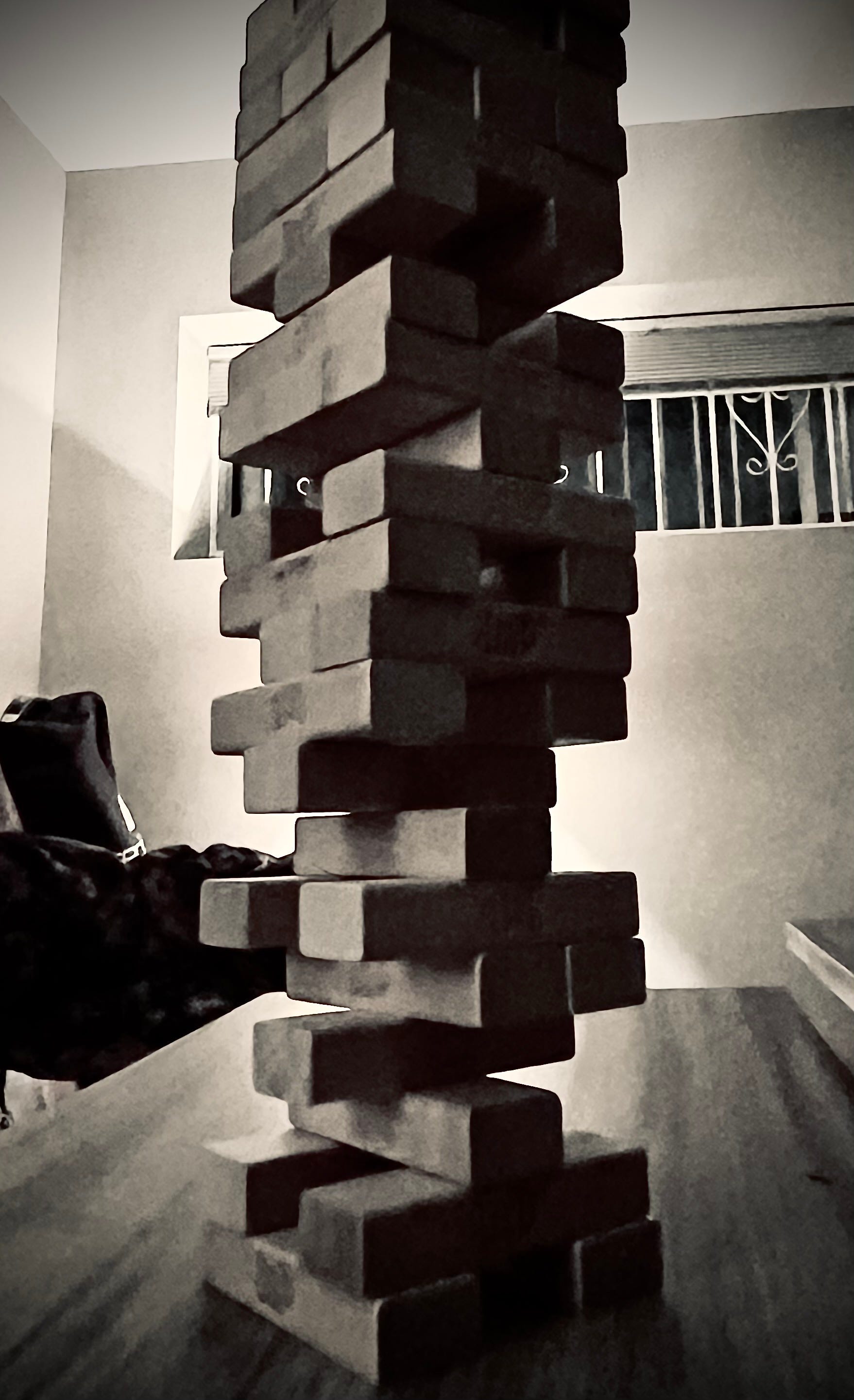
Jenga As Teacher

I'm afraid of success. And so are you.
Success is like jenga. Each block represents an element of stability. Stacked again and again in layers without deviation, we get a stable freestanding structure.
Staying that way, however, isn't the point of playing. We need to take it apart to do that. Initially, it may be stable, but it's hardly remarkable.
By following conventions laid at our feet about how to be safe, we end up generic, but to the success oriented, this is where the fun begins.
Jenga's initial form represents what Sartre calls 'bad faith'. The initial form of the tower is meant to look like it shouldn't be any other way - conforming, if you will - trapping us to fear making a move that would cause the structure to collapse. But once we know how the game is played, it dares us to challenge safety in order to build an individual's version of greatness.
As moves compound, we end up seeing something more unique and wonderful, yet also ever more dangerous due to the pain it would cause to see all our hard work topple over.
I'm constantly scared to move the blocks of my life's jenga tower. As I'm sure you are too.
But the alternative is staying locked into a shape that came from a box, sold to millions as a place to start, while, in reality, we were designed to be experimental.
Life is jenga. How well you play determines how skillfully you will build yourself. Failure, no matter how messy, is just a part of that game.
For us who are daring to be brave, we know what shape the tower was when started. The only real consequence is to rebuild it, start the experiment over, adding the lessons from each previous attempt, crafting new strategies along the way that continue to evolve with our vision of the perfect game.